
Managing Insider Risk From Contractors and Third Parties
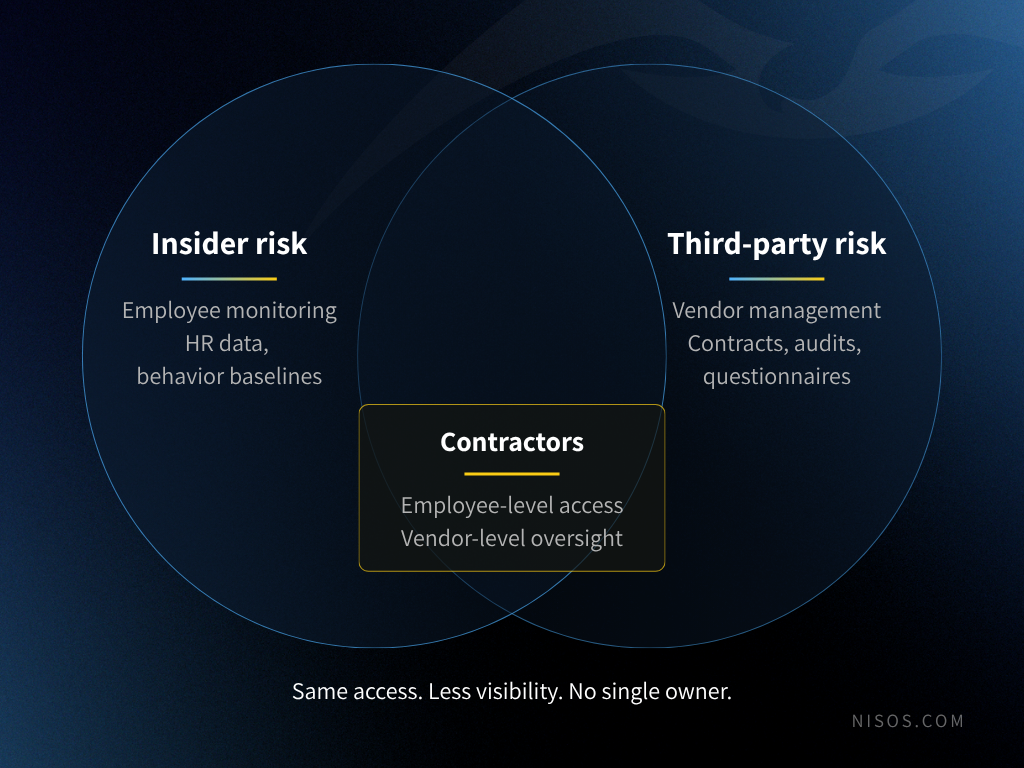
Most insider threat programs focus on employees. Most third-party risk programs focus on vendors. Contractors often sit between the two, creating gaps in visibility, monitoring, and ownership.
Contractor Risk at a Glance
Contractor risk sits between insider threat and third-party risk programs. Here’s what organizations should know:
- Contractors often receive employee-level access without the same governance processes.
- Insider threat and third-party risk programs frequently leave gaps in contractor oversight.
- The most common risks include excessive access, inconsistent offboarding, and limited monitoring.
- Effective contractor risk management combines access controls, continuous monitoring, and external intelligence.
What Is Contractor Risk?
Contractor risk refers to the security and insider risks introduced by individuals who receive authorized access without becoming permanent employees.
Unlike traditional vendors, contractors often work inside an organization’s environment. They use company systems, handle sensitive information, and may receive privileged access to critical infrastructure. At the same time, they frequently fall outside many of the governance processes built around full-time employees.
That overlap creates risk neither program was originally designed to manage on its own.
Are Contractors Considered Insiders?
Yes.
According to NIST and CISA, insider threats can include employees, contractors, business partners, and anyone with authorized access to an organization’s systems or information. The definition is based on access, not employment status.
CISA’s definition of insider threats addresses contractors and vendors directly: “third-party threats are typically contractors or vendors who are not formal members of an organization, but who have been granted some level of access to facilities, systems, networks, or people to complete their work.”
The issue isn’t whether contractors qualify as insiders. It’s that many organizations manage contractor access separately from insider threat programs, creating gaps in monitoring and accountability.
Where Contractor Risk Falls Through the Cracks
Employees move through structured HR processes. Vendors move through procurement and due diligence. Contractors often experience parts of both, but rarely the full oversight of either.
That difference can make contractor activity harder to monitor and investigate.
Why Contractor Risk Goes Unmanaged
Contractor risk rarely comes from contractors being inherently riskier than employees. It comes from gaps in governance — gaps that exist for structural reasons, not because anyone is being careless.
Broad access granted too quickly.
Business needs often require contractors to start work immediately, leaving little time to review whether the access being granted matches what the work actually requires.
Monitoring that stops at employees.
Most insider threat tools were built around employee behavior baselines. Contractor accounts often fall outside that baseline by default.
Shared credentials.
When multiple people use the same account, there’s no clean way to tie a specific action back to a specific person, which makes investigation difficult even when something does go wrong.
Access that outlives the engagement.
Without a structured offboarding process, contractor accounts can remain active long after the work is done.
Fragmented ownership compounds all of this.
Security, procurement, and vendor management may each assume someone else is responsible for contractor oversight. That assumption, repeated across three teams, is how contractor accounts go unmonitored for months without anyone noticing.
Signs of Contractor Insider Threats
Threats rarely show up as a single action. They show up as a pattern, and the pattern is usually visible if someone is looking in the right place.
Behavioral indicators include:
- Access outside assigned responsibilities
- Large or unusual data downloads
- Repeated requests for elevated privileges
- Continued access after a contract ends
- Shared credentials
- Logins from unexpected locations
External indicators include:
- Individual stressors, including personal challenges and financial pressure
- Grievance against the organization, instability, or behavioral volatility
- Potential influences or exposures outside the organization
In isolation, none of these behaviors automatically indicate malicious intent. But they may warrant a closer look, especially when multiple signals surface.
How to Manage Contractor Risk
Managing contractor risk requires consistent governance throughout the engagement.
Limit access.
Apply least-privilege access and review permissions regularly. Contractors should only have access to what their current work requires, nothing broader.
Tie access to contracts.
Access should expire automatically when the engagement ends, not as a manual step someone has to remember to execute.
Monitor contractor activity.
Behavioral monitoring should extend to contractor accounts specifically, with its own baseline, rather than treating it as an afterthought to employee monitoring programs. In one case, Nisos helped a client identify the source of a trade secret leak, enabling them to confirm the breach and take action quickly.
Add external intelligence.
Internal monitoring shows what happens after access is granted. External intelligence can identify public risk signals, undisclosed affiliations, and reputational concerns before a contractor ever enters the environment. In one engagement, Nisos helped a global distributor verify the reputation and affiliations of a third-party relationship before trust was extended, surfacing what internal vetting couldn’t independently validate.
Closing the Gap
Contractor risk isn’t exclusively an insider threat problem or a third-party risk problem. It’s a human risk challenge that requires organizations to understand who has trusted access, how that access is monitored, and where visibility gaps exist before an incident makes them visible for you.
Because the difference between an employee and a contractor matters far less than the access they have, and whether anyone is watching it.
To go deeper, explore how Nisos approaches Human Risk Intelligence, and see how Insider Threat Intelligence and Third-Party Intelligence work together to cover the people traditional security programs often overlook. For higher-stakes contractor relationships, Investigations can surface risk before access is ever granted.
Frequently Asked Questions (FAQs) on Insider Risk From Contractors and Third Parties
Are contractors considered insiders?
Why do contractors create insider risk?
How do you manage contractor insider risk?
What's the difference between insider threat and third-party risk for contractors?
What are common signs of contractor risk?
About Nisos®
Nisos is a trusted digital investigations partner specializing in unmasking human risk. We operate as an extension of security, risk, legal, people strategy, and trust and safety teams to protect their people and their business. Our open source intelligence services help enterprise teams mitigate risk, make critical decisions, and impose real world consequences. For more information, visit: https://nisos.com.