
Digital Risk to Executives: Why HR Plays a Critical Role in Executive Protection
Executive Impersonation and Digital Risk: A Wake-Up Call
Sarah, the company’s CFO was halfway through her morning when her phone rang. Without looking at the caller ID, she answered. “Sarah, it’s me. I’m calling from San Francisco.” It was her CEO’s voice. “I’m in transit and can’t get to my email at the moment. One of our vendors is waiting for a late payment. Can you initiate a wire transfer immediately? I’ll text you the invoice. I’ll send you the follow-up details in a secure channel in a few minutes, but this is time-sensitive.”
This wasn’t unusual. The CEO traveled constantly and was in San Francisco for a conference. Deals and payments move fast, and the voice and tone was exactly right — familiar and calm, but urgent. Sarah reached for her laptop, but hesitated. Not because the request was that strange, but because something felt too perfect. She followed security protocols and sent him an internal message.
Sarah: “Hey, I have a question.”
CEO: “Hey Sarah, what’s up?”
Sarah: “I’m just confirming details on the wire transfer.”
CEO: “What wire transfer?”
She froze.
Sarah: “I just spoke to you.”
CEO: “No,” he said slowly. “You didn’t.”
This wasn’t just phishing. It was a surgical strike against executive credibility using a synthetic voice. There was no breach and no hacking. Just exposure.
Later, the security team identified the probable source of the CEO’s voice — a recording from a conference keynote the CEO had given months earlier. It was a polished video, publicly posted on LinkedIn, and was enough audio for an AI model to replicate his voice.
The attacker knew:
- The CEO’s travel schedule from LinkedIn
- The CEO’s voice from a previously recorded video
- The CFO’s authority and workflow from company emails exposed in a data breach
- Enough personal detail from company bios to make the request believable
HR’s Duty of Care: Managing Digital Risk to Executives
Executive protection used to mean physical security. Secure buildings, offices, and transportation, vetted locations, and bodyguards. But today, the fastest path to an executive is digital.
Unlike physical security, which naturally sits with specialized teams, digital executive protection lives at the intersection of people, risk, and organizational duty of care. And that intersection is HR’s domain. Because it’s not about network security or firewalls. It’s about human vulnerability, duty of care, and protecting your most valuable people from threats that target them as individuals, not just as employees.
Attackers don’t need to breach corporate systems first. They exploit what already exists outside the system:
- Public speaking clips that enable voice cloning
- Home addresses in property records
- Phone numbers sold through data brokers
- Credentials exposed in third-party breaches
- Family details posted on social media
- Travel patterns tied to conferences and posts
This creates a modern risk reality: executives are now high-value targets because of their personal digital footprint.
How Executive Protection Builds Employee Trust: The HR Advantage
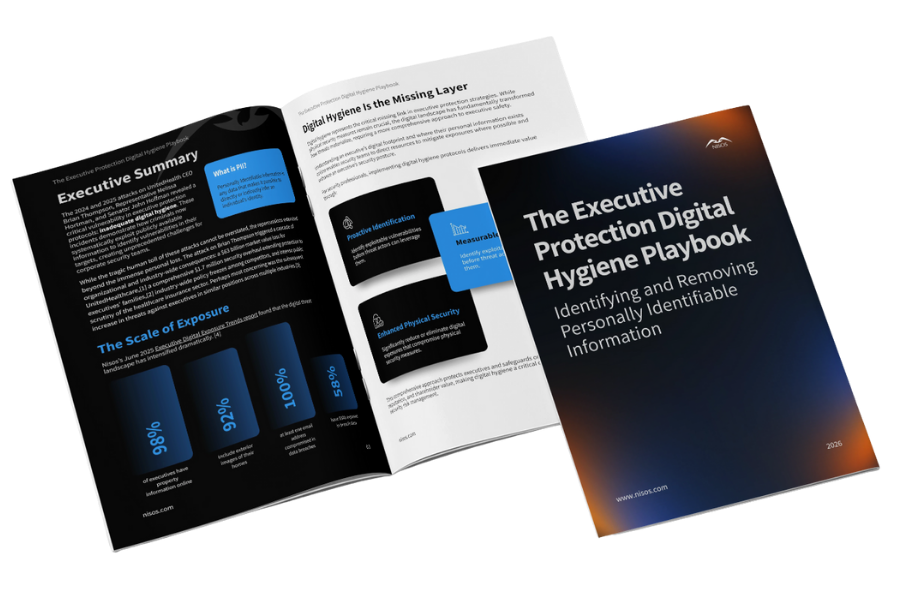
When employees understand that the company is actively protecting them from external threats by securing their exposed data, identifying impersonation attempts, and monitoring for credential compromises, it changes the security conversation from compliance obligations to mutual protection. This builds a more resilient, aware, and loyal workforce. To help organizations address this critical vulnerability, we’ve developed a comprehensive playbook that provides:
- A framework for assessing executive digital footprints and identifying critical exposures
- Detailed insights into the digital exposure ecosystem including data brokers, public records, social media, and dark web sources
- Strategic approaches to PII management and implementation considerations
- Practical solutions to common challenges in digital hygiene programs
- A 30/60/90-day implementation roadmap
- Evaluation criteria for selecting the right digital hygiene approach for your organization
Executive Protection Implementation Roadmap for HR Teams
Here’s how forward-thinking HR teams are implementing executive protection initiatives:
- Within the first week, new executives receive comprehensive exposure assessments.
- Establish a formal function responsible for continuous monitoring and exposure reduction across the leadership team.
- Track what matters to the board:
- Exposure reduction over time
- Threats detected and neutralized before they manifest
- Percentage of leadership with active protection
- Time from detection to mitigation for new exposures
Next Steps for Reducing Digital Risk to Executives
The digital shadow follows everyone, but it follows your executives with particular intensity. Their information is more valuable, more frequently collected, and more systematically weaponized. As HR professionals, you’re uniquely positioned to address these issues. You own executive onboarding and development, duty of care, and the relationship with leadership that makes these sensitive conversations possible.
Most executive-focused attacks don’t start inside your systems. They start with what’s already exposed.
Download the Executive Protection Digital Hygiene Playbook to help your HR team identify digital risk to executives, reduce exposure, and strengthen duty of care across your leadership team
Frequently Asked Questions (FAQs) on Digital Risks to Executives
What is digital risk to executives?
How are executives targeted through digital exposure?
Why are executives high-value targets for cyber threats?
What can organizations do to reduce digital risk to executives?
What role does HR play in reducing digital risk to executives?
About Nisos®
Nisos is a trusted digital investigations partner specializing in unmasking human risk. We operate as an extension of security, risk, legal, people strategy, and trust and safety teams to protect their people and their business. Our open source intelligence services help enterprise teams mitigate risk, make critical decisions, and impose real world consequences. For more information, visit: https://nisos.com.