
Blog
Executive Exposure is Persistent: Why You Need Continuous PII Monitoring and Removal
Exposed personal data is fueling executive impersonation, fraud, and social engineering. Here's what enterprise leaders need to know.
In today’s digital environment, the personal data of executives, key personnel and employees is not only highly exposed, it’s also an incredibly dangerous tool in the wrong hands. Personally identifiable information (PII) is being scraped, sold, and weaponized with increasing speed and precision, creating ongoing digital risk for organizations.
From corporate bios and real estate records to social media and public filings, the digital footprint of your leaders creates a blueprint for impersonation, fraud, and social engineering. What was once considered a privacy concern is now a fast-moving enterprise risk.
Our recent Executive Digital Exposure Trends report found an average of 95 instances of exposed PII per executive across approximately 200 popular data broker and aggregator sites. This level of persistent exposure underscores a growing reality: one-time removal efforts are no longer enough. To stay ahead of adversaries, organizations need a continuous and proactive approach to executive PII monitoring and takedown.
Executive PII Exposure Is a Launchpad for Digital and Physical Threats
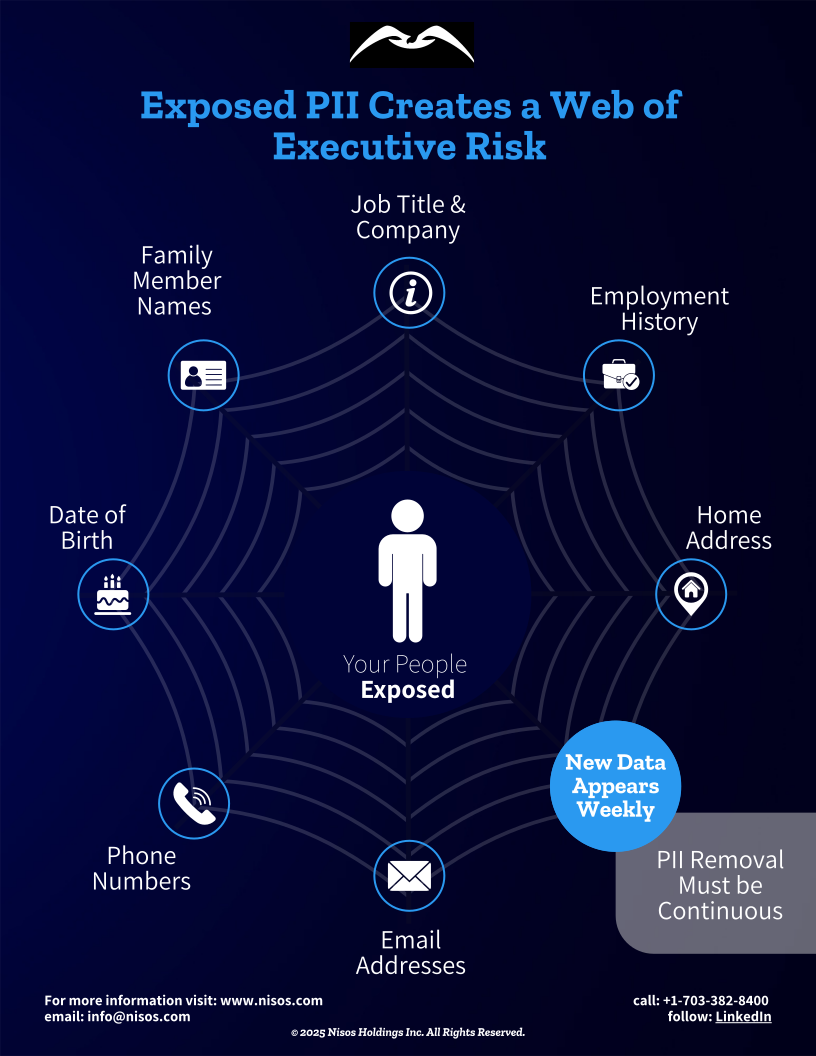
Executives, board members, and other key personnel are prime targets for impersonation, fraud, and social engineering. Names, emails, mobile numbers, home addresses, and even family connections are routinely harvested from public sources and data brokers. This widespread exposure contributes to serious human risk.
This personal data is then used to:
- Impersonate executives via email, phone, or social media
- Conduct smishing, vishing, or deepfake-enabled scams
- Target executives’ family members with threats or manipulation
- Facilitate account takeovers or identity-based attacks
- Undermine corporate reputation and brand trust
Each exposed data point is a thread that can be pulled to unravel corporate defenses and exploit human vulnerabilities to bypass traditional cybersecurity tools entirely.
Why Executive PII Exposure Has Become an Enterprise Risk
The growing web of executive exposure is not just a privacy issue - it’s a serious security liability. Without continuous monitoring and suppression, organizations leave a wide attack surface open to adversaries. That risk includes not just the executives themselves, but their families, direct reports, and internal networks.
Each exposed profile fuels multiple threats, including:
- Business email compromise (BEC)
- Voice phishing (vishing) and SMS phishing (smishing)
- Deepfake-enabled fraud
- Reputational damage and legal risk
- Physical safety threats
Organizations cannot mitigate risks that they cannot quantify. Security, HR, and executive leadership teams need real-time visibility into executive PII exposure to proactively reduce threats to individuals and safeguard the broader enterprise.
Industry leaders must integrate executive PII monitoring and takedown into a broader strategy that spans human risk, insider threat mitigation, digital executive protection, and brand trust. Continuous PII removal isn’t just a security control, it’s a core component of enterprise risk management and executive protection programs.
Why One-Time PII Removal Isn’t Enough to Reduce Risk
Identifying where your PII exists and taking active steps to remove it is an important part in reducing the risk to your executives and your organization. However, when it comes to PII, even the most effective takedown is often short-lived.
PII exposure is not a one-time event - it’s a recurring cycle.
After a single removal effort, personal data often reappears through:
- Routine data broker refreshes (every 30–90 days)
- New public content, including corporate bios, press releases, or social posts
- Affiliations and filings, such as nonprofit boards or real estate records
- Old breach data resurfacing on dark web forums
As long as data about your executives is being published, tracked, or sold, it will continue to leak, and attackers are quick to exploit it. Traditional takedowns are reactive, fragmented, and temporary. They rarely prevent reposting, mirroring, or rediscovery.
Without continuous monitoring and suppression, exposure levels rebound and risk compounds over time.
How Organizations Can Reduce Executive PII Exposure
Combating PII exposure requires more than a one-time removal; it demands a consistent, hands-on strategy. While the digital landscape is always evolving, organizations can take clear, repeatable steps to reduce digital risk and strengthen protection for their leadership teams.
The first step is identifying and requesting the removal of residential addresses, contact information, and other personal details from high-visibility sources such as people search engines, data broker platforms, and aggregation sites. Many of these sites have opt-out processes that allow individuals to request takedowns, especially when requests are submitted through a verified business or attributed email.
Because some platforms periodically refresh or repopulate data from public sources, it’s important to treat PII removals as part of a recurring process, not a one-time task. This makes continuous monitoring essential to identify new exposures as they appear. Regular reviews and resubmissions help ensure that once-removed data doesn’t return over time.
Direct involvement from executives may be required. Some platforms may require the executive to take specific actions, such as responding to confirmation emails or submitting documentation to verify their identity. In these cases, success often depends on having a clear process, well-defined responsibilities, and internal coordination between security, HR, and executive teams.
Turning Visibility Into Executive Risk Reduction
Even among Fortune 100 companies - who often have the most robust digital protection strategies - executives have dozens of active PII exposures across public platforms and third-party sites. As an individual’s digital footprint continues to grow, personal data frequently reappears online, creating an evolving challenge even for well-resourced security teams.
The good news is that the risk is manageable. With the right approach, managing executive PII exposure becomes a powerful way to reduce both individual and organizational risk. A combination of continuous monitoring, manual takedowns, and coordinated response ensures that exposed information is identified and suppressed before it can be exploited.
Whether managed in-house or with external support, this kind of proactive PII management strengthens not only the safety of individual executives, but the resilience of the enterprise as a whole. In an era where human risk is a primary attack vector, visibility and action go hand in hand.
Want to see real-world examples?
Our Executive Vulnerability Report reveals how frequently and widely PII for Fortune 1000 executives appears across public sources. The findings are eye-opening.
Learn more about Nisos Executive Shield Solutions and how we help protect your team from human-driven threats.
Frequently Asked Questions (FAQs) on Executive PII Exposure
About Nisos®
Nisos is a trusted digital investigations partner specializing in unmasking human risk. We operate as an extension of security, risk, legal, people strategy, and trust and safety teams to protect their people and their business. Our open source intelligence services help enterprise teams mitigate risk, make critical decisions, and impose real world consequences. For more information, visit: https://nisos.com.