
Why Insider Threat Programs Miss the Signals That Matter Most
Your Insider Threat Program Is Only Looking in One Direction
Organizations have poured significant resources into building insider threat programs. They have monitoring tools. They have policies. They have people responsible for managing it. And they still get caught off guard.
Not because the program failed. Because it was only ever looking inside.
Internal monitoring (DLP, UEBA, access logs, SIEM) does exactly what it was designed to do. It watches what happens on corporate systems, networks, and endpoints, and it surfaces anomalies when behavior deviates from the norm. That matters. That work is worth doing.
But it only covers half the picture.
The signals that precede insider action, like financial pressure, building grievance, undisclosed conflicts of interest, maybe even a credential quietly listed for sale on the dark web, almost always appear outside the organization before they show up inside it. And no internal monitoring tool can see them.
That is not a gap in effort. It is a gap in direction.
The Signals Living Outside Your Firewall
Here is what internal tools cannot see:
Financial Pressure and Personal Stressors:
The financial pressure building outside the office that makes someone susceptible to manipulation or coercion.
Public Behavioral Indicators:
The frustration expressed publicly on social media, visible to anyone who looks, but invisible to every internal tool in your stack.
Undisclosed Conflicts of Interest:
The undisclosed second job creating a conflict of interest your program has no way to detect.
Dark Web Credential Exposure:
The corporate credential quietly listed for sale on the dark web months before anyone attempts to use it.
These signals exist. They are often accessible, in public posts, open records, and the digital footprint people leave behind in the normal course of their lives. But they live entirely outside the corporate environment.
This is the visibility gap. And closing it does not require rebuilding your program. It requires looking in a second direction.
Three More Gaps in Most Insider Threat Programs
The visibility gap is the most significant structural problem in most insider threat programs. But it is not the only one.
Siloed Functions Across Security, HR, and Legal
Security sees the technical signals. HR sees the behavioral ones. Legal gets involved after things have escalated. Leadership hears about it when the damage is done. Each function has a piece of the picture. No one has the whole thing. The information that could connect the dots, the manager who noticed something shift in an employee, the HR partner who flagged a difficult conversation, rarely gets shared in time to matter.
Stretched Teams and Ad Hoc Monitoring
The security professionals responsible for insider risk are often managing it alongside a full slate of other responsibilities. Adding systematic external signal monitoring to that workload, such as manually reviewing social media, scanning breach data, or monitoring dark web activity for mentions of employees or company assets, is not realistic at scale. So it becomes ad hoc. It happens when someone thinks to look. And the signals no one looked for are the ones that go unnoticed.
Reactive Detection Versus Proactive Risk Identification
Organizations take an average of 67 days to contain an insider incident once it has been identified (source: 2026 Cost of Insider Risks Global Report, Ponemon/DTEX). That is more than two months of potential data loss, operational disruption, and reputational exposure after the program has already detected the problem. The detection itself often comes late, after concerning behavior has been ongoing for weeks or months. The programs that prevent incidents rather than simply respond to them are built for continuous, proactive detection. They are looking for warning signs before the incident, not building the case after it.
What a More Complete Insider Threat Program Looks Like
The handbook is designed to be useful whether your organization is building a trusted workforce program for the first time or maturing an existing one. A self-assessment in the final section helps readers locate themselves on the maturity spectrum and identify the most productive next step, whether that is establishing program foundations, strengthening specific areas of the program, or adding external intelligence capability to a program that already has strong fundamentals.
It is not written for organizations that have insider risk fully solved. It is written for the ones doing the hard work of getting there.
Start With an Honest Assessment
If these gaps sound familiar, you are not alone. They are structural characteristics of how most insider threat programs have been built, not failures of individual teams or organizations.
The right starting point is an honest assessment of where your program’s coverage ends. A few questions worth asking:
- What signals are we missing because we are only looking inside the firewall?
- What would it look like to detect a risk earlier, before it becomes an incident?
- How do we build a program that is truly cross-functional?
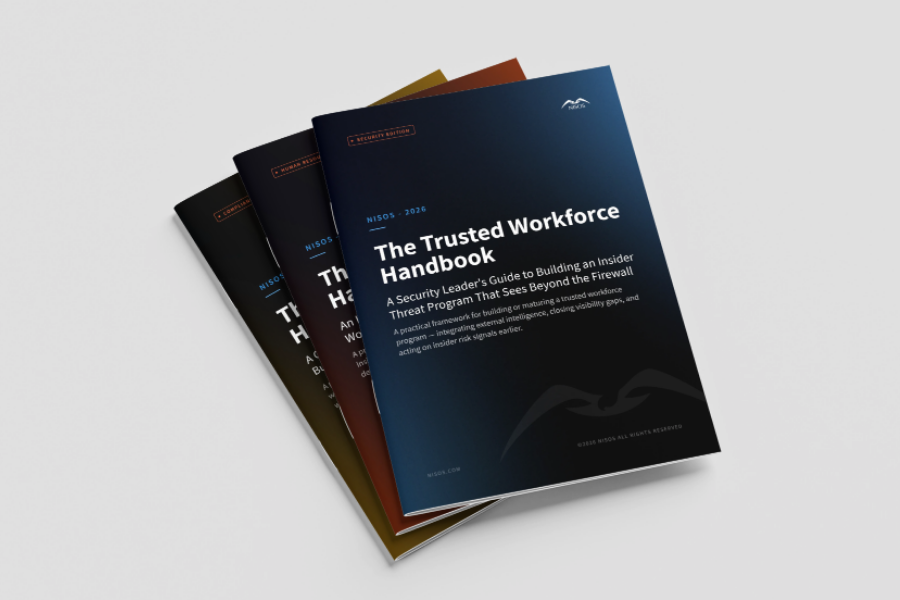
We can help you get started. The Trusted Workforce Handbook was built to help you address these questions. It covers the full signal landscape, the cross-functional program design that closes the siloed ownership problem, and a practical self-assessment that helps organizations identify where their program stands and what to prioritize next. It is available in three editions, for security leaders, People and HR leaders, and Compliance and Risk leaders, because insider risk is not owned by any single function.
Frequently Asked Questions (FAQs) on Insider Threat Programs
What is an insider threat program?
What external signals can help identify insider risk?
How long does it take organizations to contain an insider threat incident?
According to the 2026 Cost of Insider Risks Global Report from Ponemon and DTEX, organizations take an average of 67 days to contain an insider incident after it has been identified. In many cases, concerning behavior has already been developing for weeks or months before detection occurs.
Do organizations need to rebuild their insider threat program?
What is the Trusted Workforce Handbook?
About Nisos®
Nisos is a trusted digital investigations partner specializing in unmasking human risk. We operate as an extension of security, risk, legal, people strategy, and trust and safety teams to protect their people and their business. Our open source intelligence services help enterprise teams mitigate risk, make critical decisions, and impose real world consequences. For more information, visit: https://nisos.com.