
When AI Becomes the Threat: How Generative Models Are Weaponizing Your Executives’ Personal Data
How AI Became an Intelligence Amplifier
A software developer in Israel thought he was dealing with spam until he saw the screenshot. Google’s Gemini AI had provided his personal phone number as customer service contact information for a company he’d never worked for. The number had been posted once, nearly a decade ago, on a local forum, and now AI was surfacing it to anyone who asked.
This isn’t an isolated incident. According to MIT Technology Review, customer complaints about personal information being surfaced by large language models have increased 400% in seven months, with queries that “specifically reference ChatGPT, Claude, Gemini … or other generative AI tools”. For security and HR leaders, this represents a fundamental shift in the threat landscape: AI isn’t just changing how attacks happen, it’s dramatically lowering the barrier to finding and weaponizing personal information about your executives, employees, and key personnel.
What AI Can See About Your Executives
Your executives’ personal data is more accessible than they realize. Phone numbers, home addresses, family members’ names, and behavioral patterns that were once buried in forgotten forum posts or obscure data broker sites are now instantly accessible to anyone with an AI prompt.
As one University of Washington PhD student discovered when testing Gemini, “Having your information be … accessible to one audience, and then Gemini making it accessible to anyone” creates an entirely different risk profile. Information that was previously “severely downgraded” in traditional search results (requiring someone to dig through multiple pages) is now surfaced instantly by AI systems trained on massive web scrapes.
This represents exactly the kind of outside-the-firewall risk that traditional security tools can’t see. Your SIEM might catch an attempted network intrusion, but it won’t alert you when an AI system starts serving up your CEO’s personal phone number to strangers.
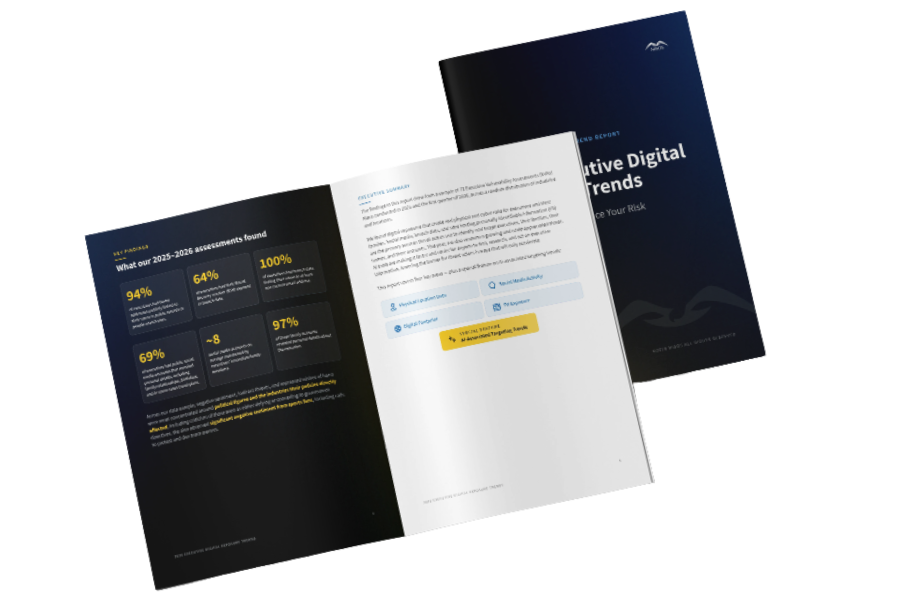
This shift is reflected in our 2026 Executive Digital Exposure Trends Report, which examines how AI is accelerating reconnaissance and increasing executive digital exposure across industries.
How Personal Data Ends Up in AI Systems
The scale of personal information flowing into AI training datasets is staggering. According to the California data broker registry, 31 of 578 registered data brokers have “shared or sold consumers’ data to a developer of a GenAI system or model in the past year”. Each data point, whether a phone number shared in a 2015 forum post, an address from a real estate listing, or family details from social media, becomes permanent ammunition in AI systems that can reproduce this information verbatim.
The MIT Technology Review investigation revealed how ChatGPT can be coaxed into an “investigative-style approach,” where providing just a neighborhood guess and possible co-owner name led to the system producing “the professor’s home address, home purchase price, and spouse’s name from city property records”.
For security teams, this should sound familiar. It’s the same pattern-of-life intelligence that sophisticated threat actors use for social engineering, executive targeting, and preliminary reconnaissance. Except now it’s available to anyone with basic prompt engineering skills.
Why Traditional Privacy Measures Aren’t Enough
The problem isn’t just that personal information is exposed, it’s that there’s no clear path to removing it once it’s embedded in AI training datasets. As Stanford’s Jennifer King notes, “I don’t know if Google even has the infrastructure … to say to me, ‘Yes, we have your data in our training data, we can summarize what we know about you, and then we can delete or correct things that are wrong or things that you don’t want in there'”.
Current privacy legislation like CCPA and GDPR doesn’t cover the “publicly available” information that has already been scraped for LLM training. This creates a critical gap: data that executives thought was minimally exposed or long-forgotten is now permanently accessible through AI systems with no effective removal mechanism.
From Reconnaissance to Active Targeting
The real security risk isn’t just exposure, it’s how AI amplifies traditional attack vectors. Consider how this changes executive protection:
Traditional Research vs. AI-Amplified Targeting — A Side-by-Side
Traditional threat model:
An adversary spends hours researching an executive across multiple platforms, data broker sites, and public records to build a targeting profile.
AI-amplified threat model:
An adversary asks an AI system a few targeted questions and receives the same intelligence in minutes, often with additional context and connections the human researcher might have missed.
This isn’t theoretical. The MIT investigation found that AI systems don’t just reproduce individual data points, they make connections and provide context that dramatically accelerates the reconnaissance phase of targeted attacks.
Taking Action: How to Reduce Executive Data Exposure
1. Start with visibility into your people’s digital footprint.
Before personal information becomes embedded in the next generation of AI training datasets, organizations need comprehensive visibility into their executives’ digital exposure. This means systematic assessment of what’s already out there, across data broker sites, social media, public records, and the deep web sources that feed into AI training pipelines.
2. Act upstream, before data gets embedded.
The best option for anyone who wants to protect their private data right now is to act proactively before personal information becomes embedded in the next generation of AI training datasets. Since the start of the year, for instance, California has offered its residents a web portal to request that data brokers delete their information. Still, this doesn’t guarantee that your data hasn’t already been used for training, and will therefore not appear in a chatbot’s response.
3. Apply intelligence-led methodology.
This isn’t a problem that can be solved with automated tools alone. It requires the same systematic OSINT investigation and manual verification that intelligence professionals use, applied proactively to reduce exposure before it becomes weaponized.
The Window Is Closing
The AI training arms race shows no signs of slowing. As “public data runs out,” AI companies are turning to data brokers and people-search websites to feed their models. Every day that passes means more personal information about your executives becomes permanently embedded in AI systems designed to make that information easily accessible.
For organizations serious about executive protection and insider threat prevention, the question isn’t whether to address digital exposure, it’s whether to address it before or after an adversary demonstrates just how much they can learn about your people with a few well-crafted prompts.
The threats that target your executives, infiltrate your workforce, and compromise your operations don’t announce themselves. They start with reconnaissance. And now, AI has made that reconnaissance faster, deeper, and more accessible than ever before.
Want to understand what AI systems can already reveal about your executives? Our Executive Vulnerability Assessments, part of our Executive Shield solution, model the attacker’s perspective, showing you exactly what an adversary can see, and what you can do about it before it becomes a problem.
See the Full Picture of Executive Digital Exposure
AI is accelerating reconnaissance, but it is only one part of the risk. The 2026 Executive Digital Exposure Trends Report examines physical location data, social media activity, breach exposure, personally identifiable information on data broker sites, and emerging AI-associated targeting trends.
The findings are based on real executive vulnerability assessments and show how scattered personal information can be connected, surfaced, and used against high-visibility individuals.
Frequently Asked Questions on AI Executive Digital Exposure
What is AI executive data exposure?
How does generative AI increase executive security risks?
Can ChatGPT or other AI tools reveal personal information?
Why is executive data exposure a security concern?
What types of executive information can AI surface?
About Nisos®
Nisos is a trusted digital investigations partner specializing in unmasking human risk. We operate as an extension of security, risk, legal, people strategy, and trust and safety teams to protect their people and their business. Our open source intelligence services help enterprise teams mitigate risk, make critical decisions, and impose real world consequences. For more information, visit: https://nisos.com.