
Your SIEM Can’t See This: The External Signals Your Insider Threat Program Is Missing
Your SIEM Is Working. That’s Not the Problem.
If you run an insider threat program, your Security Information and Event Management platform (SIEM) is probably doing its job. It is aggregating log data, correlating events, and surfacing anomalies when user behavior deviates from baseline. It is catching what it was designed to catch.
The problem is not your SIEM. The problem is what your SIEM was never designed to see.
Where SIEM Visibility Ends
A SIEM platform ingests data from across your environment, sourced from endpoints, network traffic, authentication logs, cloud activity, Data Loss Prevention (DLP) alerts, User and Entity Behavior Analytics (UEBA) and more, looking for patterns that indicate something may be wrong.
It is exceptionally good at answering one question: what is happening inside the network right now?
It is structurally incapable of answering a different question: what is developing outside the network that will eventually show up inside it?
That distinction matters because insider risk does not begin at the keyboard. It begins with a person: their circumstances, their pressures, their grievances, their decisions. And those conditions develop in the external world, often long before they produce any anomaly that internal tooling can detect.
By the time your SIEM fires an alert, the risk has usually already arrived.
The Signals Living Outside Your Stack
Open-source intelligence (OSINT, meaning intelligence gathered from publicly available and legally accessible sources) surfaces a category of signals that no internal monitoring tool is built to capture.
These may include:
- Credential exposure — corporate login details appearing in breach datasets, sometimes months before anyone attempts to use them
- Behavioral and sentiment shifts — public expressions of grievance, frustration, or disengagement that predate any internal anomaly
- Undisclosed affiliations — connections to competitors, threat actors, or organizations that would raise flags if they were known internally
- Financial vulnerability indicators — publicly observable signs that an individual may be susceptible to manipulation or coercion
- External coordination — activity in forums, marketplaces, or communities where corporate access, data, or information is discussed or traded
None of these appear in your SIEM. None are captured by your DLP or UEBA platforms. They exist entirely outside the corporate environment, visible to anyone applying the right analytical approach, but invisible to every tool in a standard security stack.
The Problem Isn’t Detection—It’s Timing
The visibility gap matters beyond just coverage, because external signals tend to appear earlier in the risk pathway than internal ones. Grievance, ideation, and early preparation, the stages that precede harmful action, leave traces outside the organization before they produce detectable behavior inside it.
The organizations that identify insider risk early enough to intervene, before data moves, access is compromised, or an incident has to be contained, are the ones monitoring in both directions. Inside the network, where incidents eventually surface. And outside it, where the warning signs appear first.
This is not a theoretical advantage; it changes what is possible. Early detection means more intervention options, less damage, and a meaningful difference in outcome for the organization and the individual involved.
What This Looks Like in Practice
When a social media account surfaced claiming access to sensitive trade secrets leaked from inside a client’s factory, the client’s internal security team faced a familiar problem. Internal telemetry could show what had moved across their network. It could not tell them who was behind the external account, whether they actually had access to what they claimed, or where the leak originated.
Nisos analysts applied external open-source investigation and attribution techniques to the problem. Within a short timeframe, a probable attribution report was delivered, pointing internal investigators toward a specific individual. The client’s own telemetry then confirmed the source. They were able to act.
The internal tools did their job. But they needed external intelligence to tell them where to look.
That sequencing — external signals pointing the way, internal telemetry confirming the picture — is how the two layers are meant to work together.
SIEM Plus, Not SIEM Replaced
This is not an argument for replacing your SIEM. It is an argument for recognizing what it cannot do, and adding the layer that closes that gap.
Your SIEM remains the foundation for internal visibility. DLP catches data movement. UEBA surfaces behavioral deviations. These are necessary components of a mature insider threat program.
What they cannot provide is the external context that explains why an anomaly is happening, or the early warning that it is coming. That requires a different capability: systematic monitoring of publicly observable information, applied to populations where risk or concern is elevated, with experienced analyst judgment to separate signal from noise.
The combination is what makes a program complete. Internal telemetry shows you what is happening. External intelligence shows you what is coming.
How Complete Is Your Coverage?
If you are assessing your insider threat program, whether you are building it, maturing it, or evaluating where the gaps are, a useful starting point is asking what your current stack can and cannot see.
- Can it detect a credential appearing in a breach dataset before it is used?
- Can it surface a pattern of external grievance that precedes internal action?
- Can it identify an undisclosed affiliation that creates a conflict of interest?
- Can it flag external coordination that suggests an insider is about to act?
If the answer to most of these is no, the gap is not in your SIEM configuration. It is in the direction your program is looking.
Closing the Visibility Gap
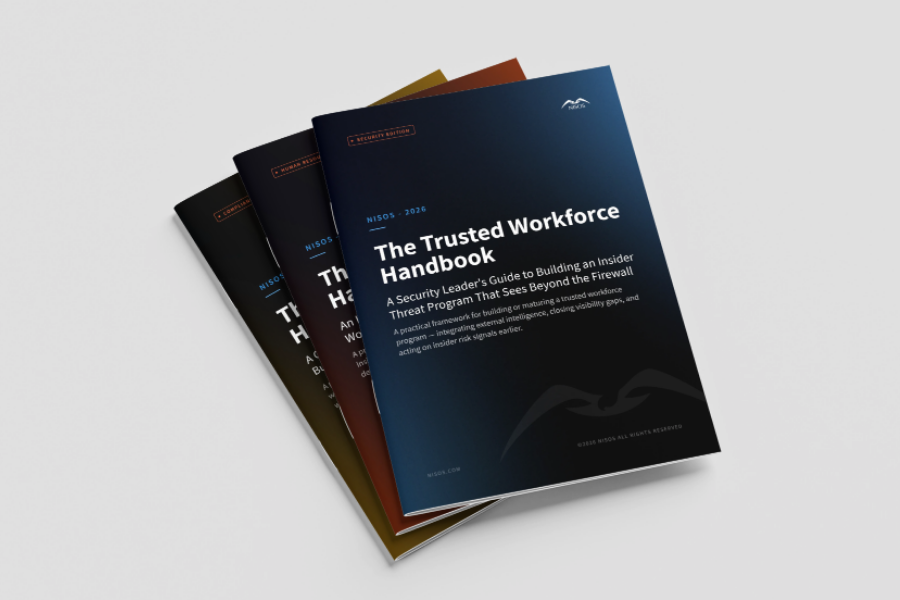
The Trusted Workforce Handbook covers the full signal landscape, internal and external, and sets out a practical framework for building a program that looks in both directions. It includes a self-assessment to help security teams identify where their current coverage ends and what to prioritize next.
Frequently Asked Questions (FAQs) on Limitations of a SIEM Platform
What are the limitations of a SIEM?
Can a SIEM detect insider threats?
What can a SIEM not detect?
How do external signals improve insider threat detection?
Does external intelligence replace a SIEM?
About Nisos®
Nisos is a trusted digital investigations partner specializing in unmasking human risk. We operate as an extension of security, risk, legal, people strategy, and trust and safety teams to protect their people and their business. Our open source intelligence services help enterprise teams mitigate risk, make critical decisions, and impose real world consequences. For more information, visit: https://nisos.com.