
Introducing the Trusted Workforce Handbook: A Practical Guide to Insider Risk for Security, HR, and Compliance Leaders
Insider Risk Programs Are Missing the Signals That Matter Most. We Wrote the Handbook.
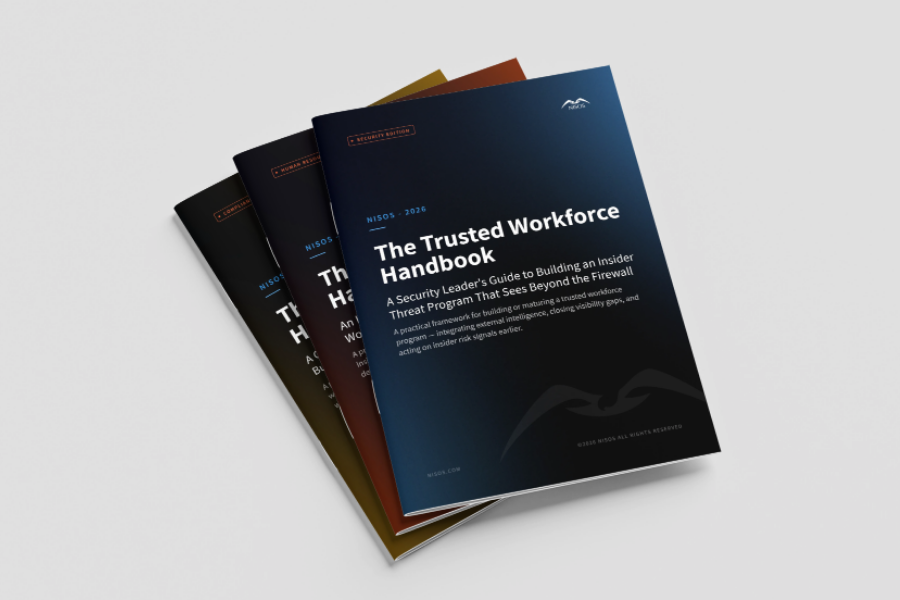
Today, Nisos published the Trusted Workforce Handbook, a practical, no-fluff guide to building or maturing an insider risk program in the modern threat environment. Download your edition here.
It is free. It is not a sales brochure. And if your organization is trying to get ahead of insider risk rather than react to it, it was written for you.
Why We Wrote the Trusted Workforce Handbook
Most insider risk programs are built on internal monitoring: logs, access records, behavioral analytics. These tools are valuable. But they share a fundamental limitation: they only show you what is already happening inside your organization.
By the time a concerning behavior registers on an internal tool, something has usually already gone wrong. The employee has already decided to act. The data has already moved, or is moving.
What most internal tools cannot see is what is happening outside the organization. The financial pressure that makes someone susceptible to manipulation. The grievance building in public posts. The undisclosed second job creating a conflict of interest. The credential quietly listed for sale on the dark web.
These signals exist. They are often accessible. And they almost always appear before anything unusual shows up inside the firewall.
The organizations that catch insider risk early are the ones looking in both places. The Trusted Workforce Handbook is a practical guide to building a stronger insider risk program and trusted workforce program that does exactly that.
What You’ll Learn About Insider Risk
The handbook addresses insider risk across the full employment lifecycle, from pre-hire screening through active employment to separation and post-employment. It covers the signals that matter, why most programs miss them, how to build a cross-functional program that addresses both internal and external dimensions of risk, and how to investigate effectively when a concern is elevated.
Specific topics include:
- The evolving definition of insider risk and why the threat landscape has changed
- A six-category signal framework covering behavioral, technical, identity, external, personal, and organizational indicators
- The structural gaps, like over-reliance on internal telemetry, siloed functions, and reactive timing, that leave most programs exposed
- A seven-step investigation workflow and RACI model for cross-team coordination
- A practical self-assessment to help organizations identify where their program stands and what to prioritize next
The handbook draws on Nisos’ years of experience supporting insider threat programs and trusted workforce initiatives. It reflects the same analyst tradecraft that has helped enterprise organizations identify threats, attribute dark web activity, and intervene before incidents escalate.
Three Editions. One Framework.
Insider risk management is not owned by any single function. It sits at the intersection of security, people, and governance. The handbook is available in three editions, each written for a specific leadership audience:
Security Leader Edition:
For CISOs, security leaders, and insider threat program managers. Focused on external signal coverage, investigation workflow, and the intelligence advantage that comes from looking beyond the firewall.
People & HR Leader Edition:
For Chief People Officers, CHROs, HR directors, and employee relations leaders. Focused on the People function’s critical role, from pre-hire fraud prevention through behavioral signal detection, intervention, and offboarding risk. Because protecting your organization and maintaining a culture of trust are not competing goals.
Compliance & Risk Leader Edition:
For General Counsel, Chief Compliance Officers, Chief Risk Officers, GRC leaders, and privacy officers. Focused on building a program that is operationally effective and legally defensible, covering policy frameworks, documentation standards, monitoring scope, and audit readiness.
All three editions share the same insider risk framework. The edition you choose shapes how that framework is presented and what it emphasizes for your role.
Whether You’re Building or Maturing a Program
The handbook is designed to be useful whether your organization is building a trusted workforce program for the first time or maturing an existing one. A self-assessment in the final section helps readers locate themselves on the maturity spectrum and identify the most productive next step, whether that is establishing program foundations, strengthening specific areas of the program, or adding external intelligence capability to a program that already has strong fundamentals.
It is not written for organizations that have insider risk fully solved. It is written for the ones doing the hard work of getting there.
Download Your Edition
The Trusted Workforce Handbook is available now, free, with no commitment required.
Frequently Asked Questions (FAQs) on Insider Risk Programs
What is an insider risk program?
Why do insider risk programs miss early warning signs?
Who should own insider risk?
How can organizations identify insider risk earlier?
What is a trusted workforce program?
About Nisos®
Nisos is a trusted digital investigations partner specializing in unmasking human risk. We operate as an extension of security, risk, legal, people strategy, and trust and safety teams to protect their people and their business. Our open source intelligence services help enterprise teams mitigate risk, make critical decisions, and impose real world consequences. For more information, visit: https://nisos.com.